Freelance developer rates
Learn how freelance developer rates vary by skill, experience, project type, location, and pricing model.


Summary
Senior freelance developers charge $75 to $150 an hour worldwide in Arc's 2026 rate guide, and juniors $20 to $50. Where your clients are based sets the ceiling. On Upwork, freelancers doing AI work earn 34% more per hour.
On this page
- Why the range is so wide
- How your tech stack affects your rate
- How experience level affects your rate
- How geography affects your rate
- How client type affects your rate
- Platform rates versus direct client rates
- How to research rates for your specific market
- How AI tools are reshaping developer rates in 2026
- How to increase your developer rate
- The real number
Freelance developer rates run from about $20 an hour for juniors to $220 for staff and principal engineers in Arc’s 2026 rate guide. That range is technically accurate and practically useless. A junior WordPress developer in Southeast Asia and a senior AI infrastructure engineer in San Francisco are both freelance developers. One figure cannot describe both.
What you actually charge, or what you should expect to pay, comes down to four variables: your tech stack, your experience level, your geography, and the type of client you are targeting. Get those four right and the number stops being a guess.
This guide breaks each variable down in detail, so you know exactly where you land and what it takes to move up.
Why the range is so wide
The range is this wide because “freelance developer” describes an enormous spectrum of people, skills, and markets. A developer building basic brochure websites occupies a fundamentally different market than one architecting distributed cloud systems for enterprise clients. They are not competing for the same work, and the same rate benchmarks do not apply to both.

Four variables explain most of the spread. Tech stack determines how many other developers can do what you do. Experience determines the complexity of problems you can solve independently. Geography anchors both your cost of living and your access to client markets. Client type shapes what the budget ceiling looks like before any negotiation begins.
Understanding how each variable works gives you something that published rate charts cannot: a framework for positioning rather than just a number to plug into your invoices.
How your tech stack affects your rate
Rates by technology follow a simple principle: they correlate inversely with the supply of experienced developers relative to demand. When qualified practitioners are scarce and demand is strong, rates go up. When the talent pool is large relative to available work, rates compress.
High-rate stacks
Rust shows the supply logic at work. Its memory safety model requires a different mental model than most languages, and demand keeps growing in systems programming, WebAssembly, and performance-critical back ends. Developers who learn it tend to stay: in Stack Overflow’s 2026 survey, 67% of developers who used Rust want to keep using it, the highest share among widely used languages. No rate survey with a stated method measures a Rust premium yet, so check current Rust contracts before you price on one.
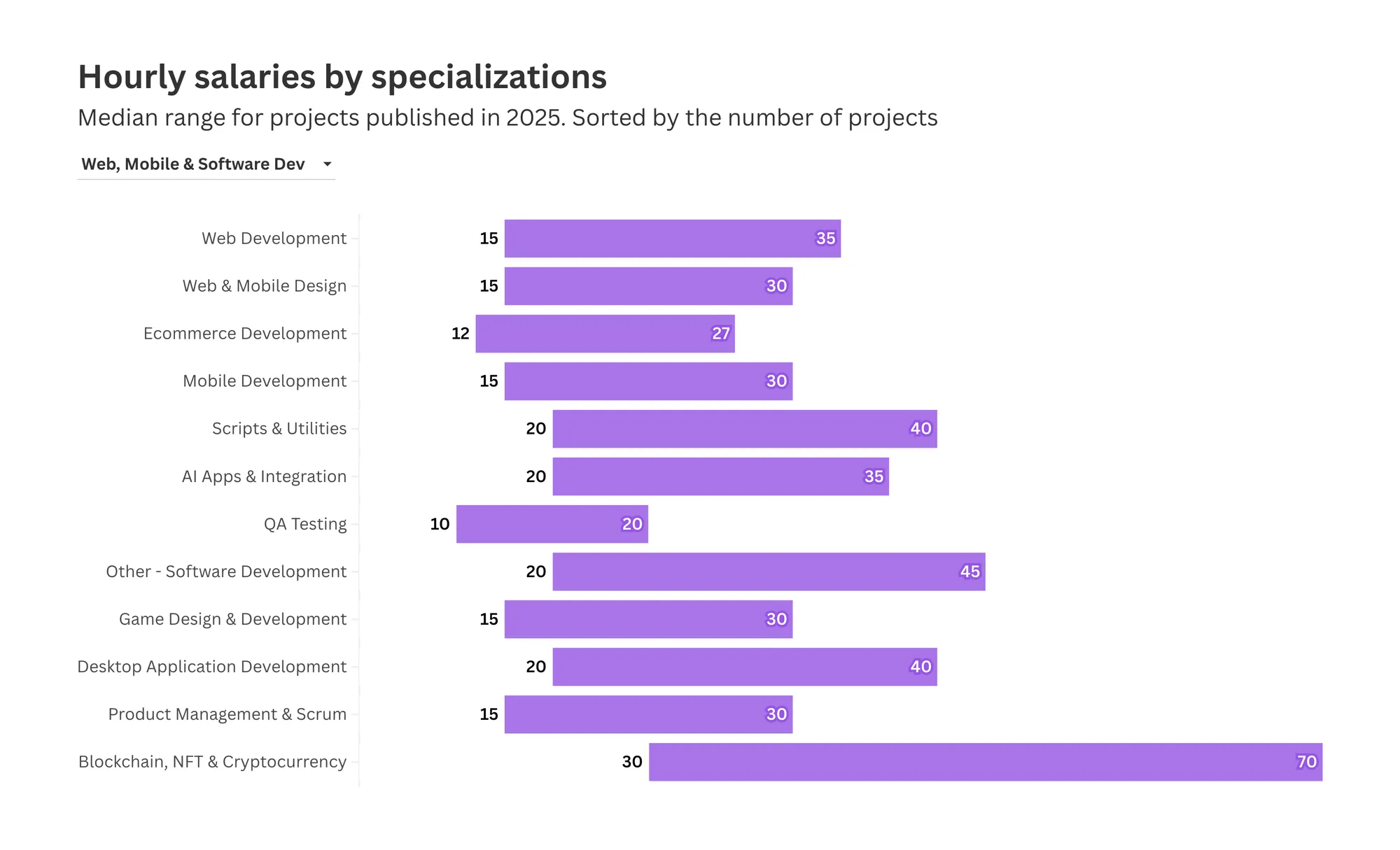
Solidity and blockchain development sit in a similar category. The knowledge is specialized, the stakes are high, and audit-level expertise is rare: only 0.8% of developers in Stack Overflow’s 2026 survey had done extensive Solidity work in the past year. Client budgets reflect it. In Vollna’s analysis of Upwork projects posted in 2025, blockchain, NFT and crypto jobs had the highest median hourly budget of any development specialty, $30 to $70, twice the $15 to $35 for web development.
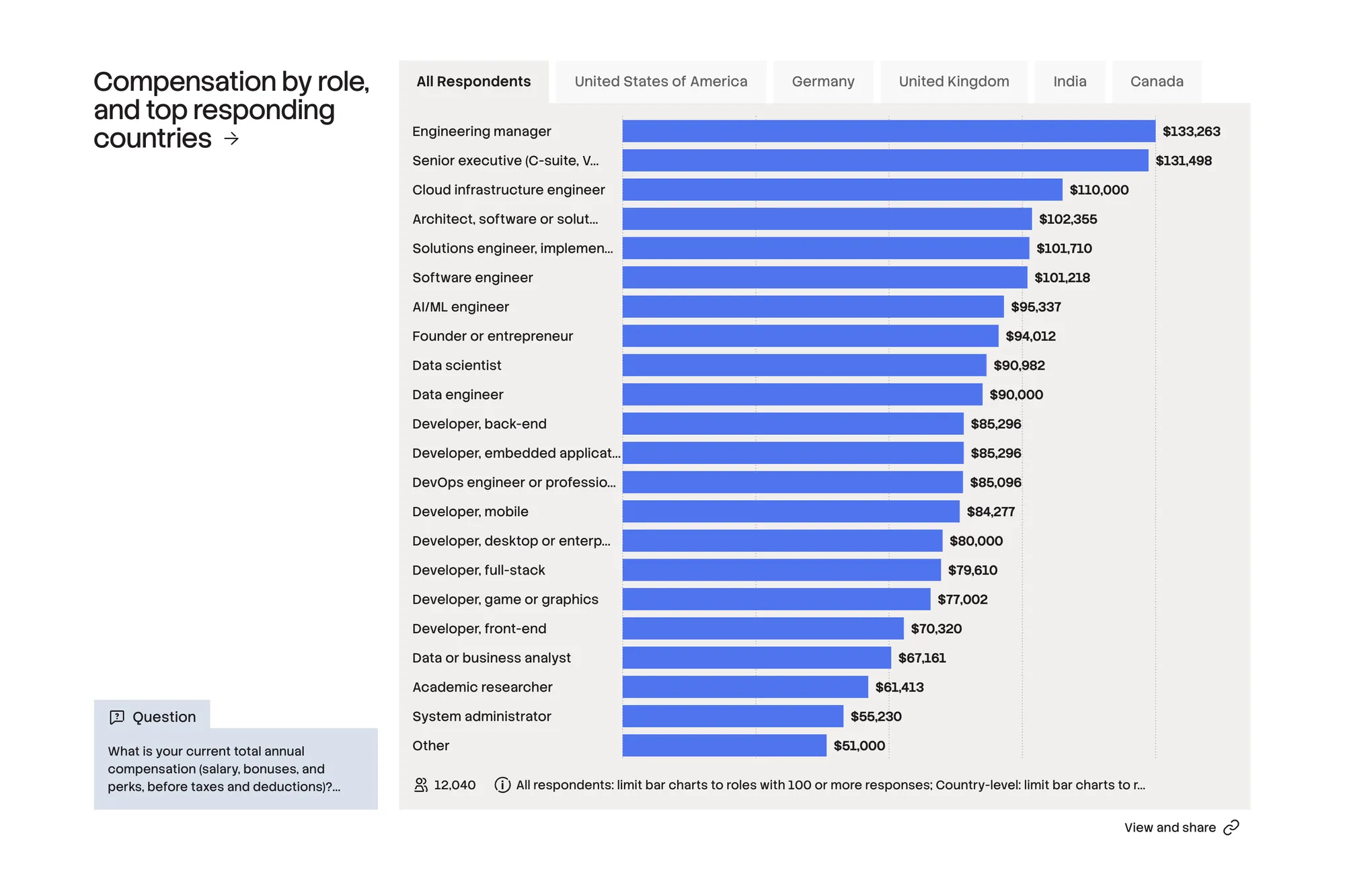
iOS development in Swift requires platform-specific knowledge that does not transfer from general web development, and enterprise clients with iOS products represent a well-funded demand base. Mobile work as a whole doesn’t pay above other development, though. In Stack Overflow’s 2026 survey, mobile developers’ median pay ($84,277) was close to back-end developers’ ($85,296), and in YunoJuno’s 2026 rates report, mobile engineers in the UK averaged £463 a day, close to front-end (£466) and full-stack (£460) engineers. A premium comes from depth in the Apple ecosystem and a record of shipped apps, not from the platform alone.
Data engineering, particularly work involving tools like Apache Spark, dbt, and Airflow, sits in a premium band. These roles sit at the intersection of software engineering and data infrastructure, requiring both disciplines at a high level. Enterprise demand is strong, and the talent pool that can work across both domains competently remains limited. In YunoJuno’s UK data, data engineers averaged £552 a day in 2025 and data architects £658, against £533 for software engineering.
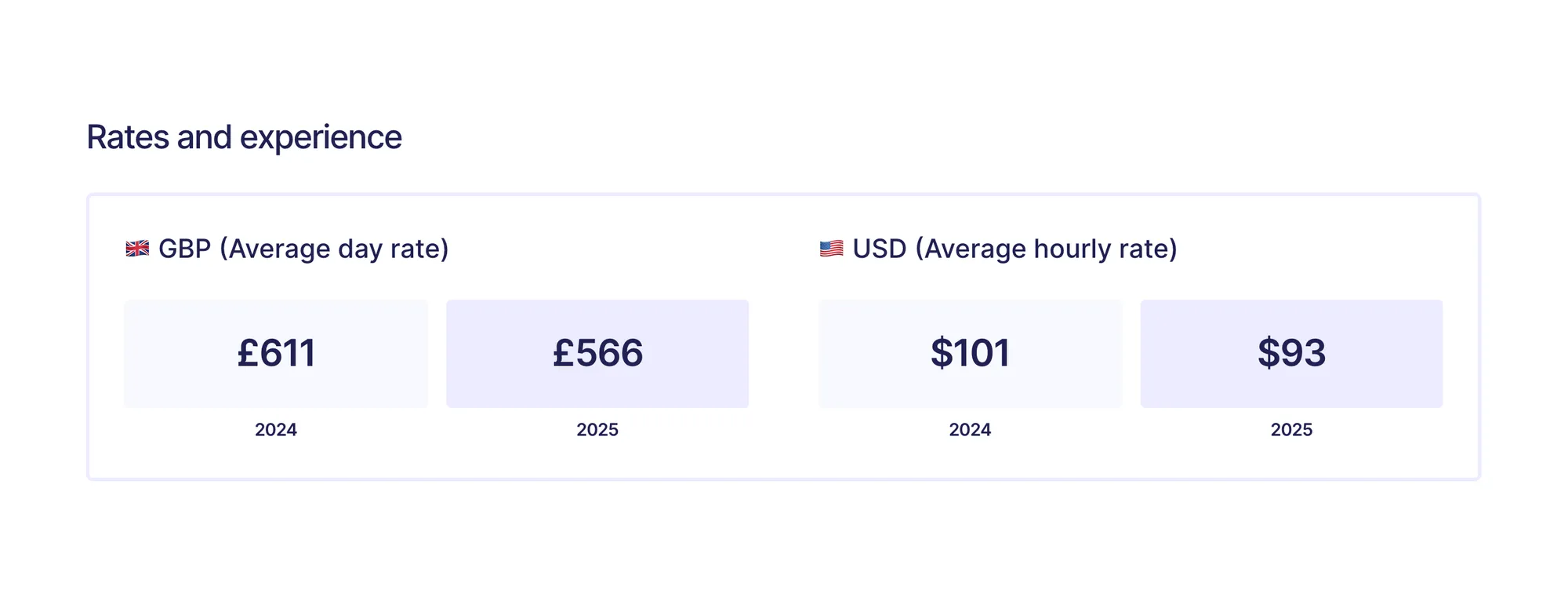
Cloud architecture across AWS, GCP, and Azure sits at the top of the market. Arc’s 2026 rate guide puts senior cloud architects at $95 to $175 an hour, and cloud and infrastructure was the best-paid of the 12 disciplines in YunoJuno’s 2026 rates report, at £566 a day in 2025, though down from £611 in 2024. These are high-stakes decisions made by developers who can be held accountable for production reliability at scale. That accountability carries a price premium.
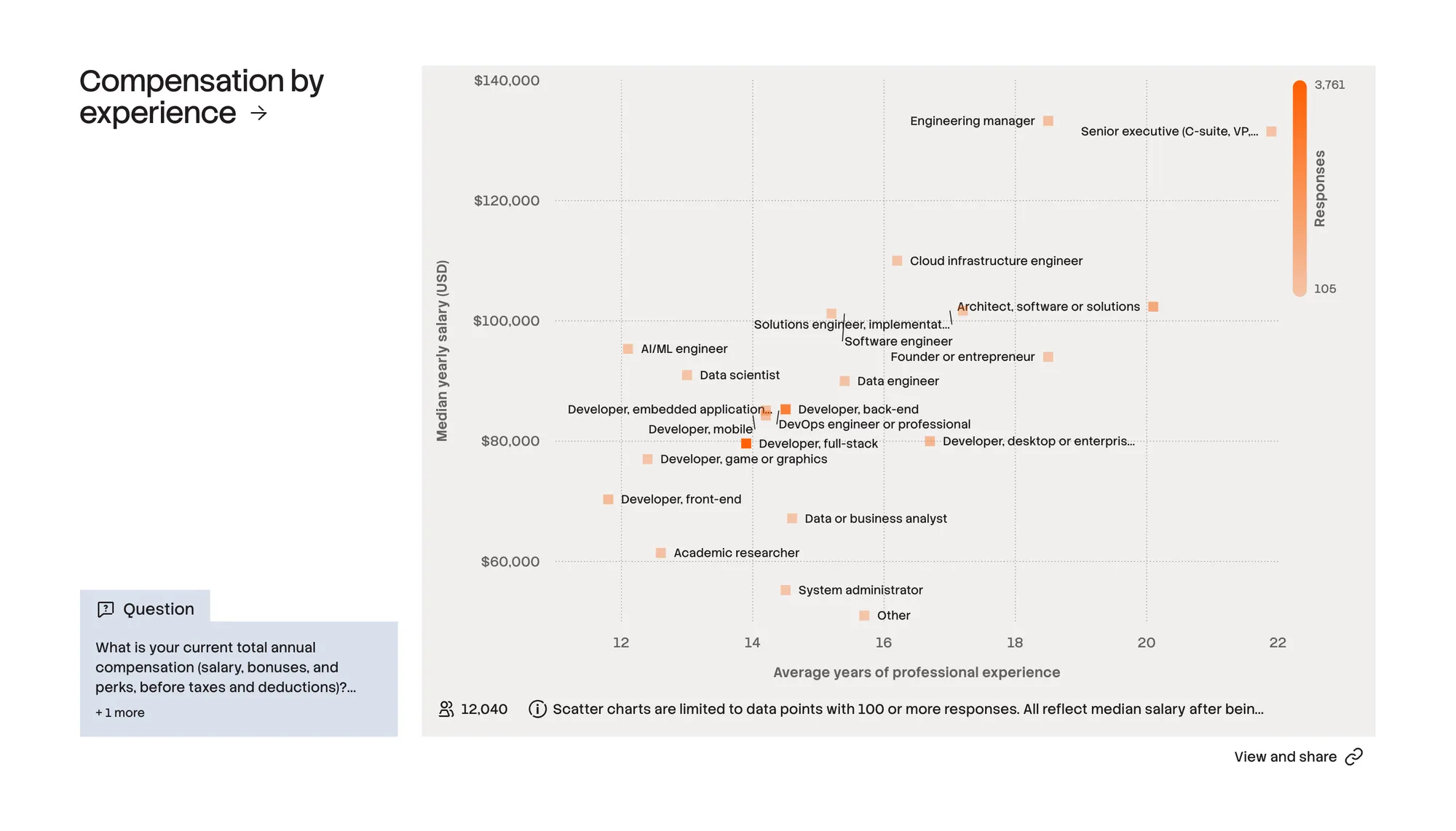
AI and machine learning work earns a premium, but it attaches to skills more than to job titles. On Upwork, freelancers doing AI work earn 34% more per hour than those who don’t, according to Upwork’s Future Workforce Index 2026, and in YunoJuno’s UK data, software engineers with AI skills charged about 26% more. The title alone is a weaker signal: YunoJuno’s AI and automation freelancers averaged £472 a day in 2025, below the £533 average for software engineering, and in Stack Overflow’s 2026 survey, AI/ML engineers’ median pay ($95,337) sat above back-end developers’ ($85,296) but below cloud infrastructure engineers’ ($110,000).
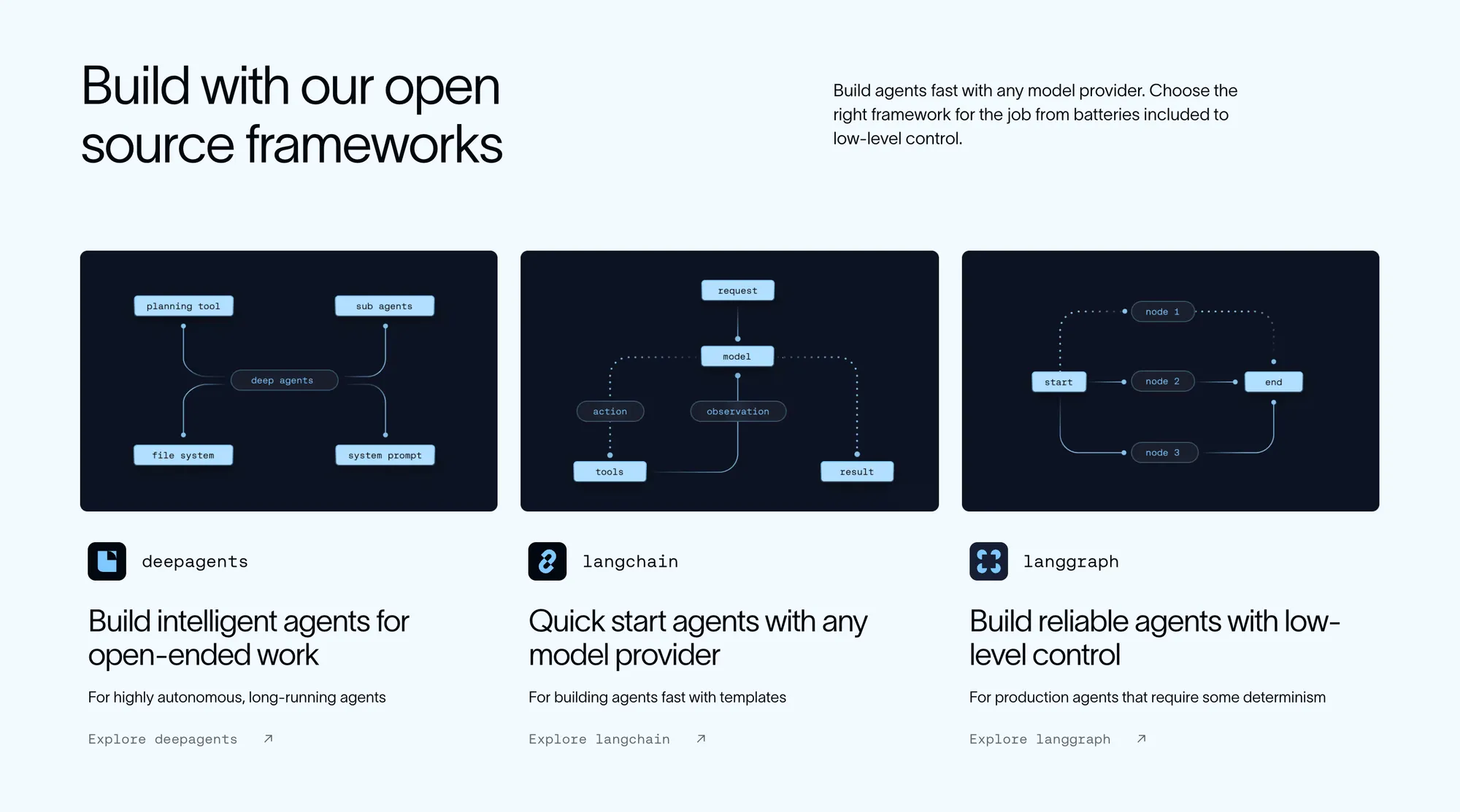
Complexity is where the premium grows. Upwork found that freelancers doing more complex work with AI earned 45% more than a year earlier, while earnings per contract for generative AI and creative production work fell 13% as that work multiplied. Building agents that hold up in production, with frameworks like LangChain or Anthropic’s Model Context Protocol, is that kind of complex work.
Mid-range stacks
Full-stack JavaScript, particularly React and Node.js combinations, sits in a highly competitive but high-demand position. The talent pool is enormous. So is the demand. Rates depend heavily on specialization depth and portfolio quality: a React generalist competes with thousands of others, while a React developer who specializes in performance optimization for high-traffic e-commerce competes with far fewer.
Python development splits sharply depending on application. Python applied to machine learning or data science pulls rates significantly higher than Python used for general web backend work. Your language choice matters less than what you build with it.
Java and Kotlin for enterprise backend work maintain steady demand from large organizations. These are not glamorous positions, but enterprise budgets are real and often substantial.
Competitive stacks
WordPress and PHP development exists at a wide price range depending on specialization. Generic WordPress development, building standard sites with off-the-shelf themes and plugins, is highly commoditized. Rates compress accordingly. Custom plugin development, WooCommerce customization for high-volume stores, and headless WordPress implementations command meaningfully higher rates because fewer developers can do that work well.

Basic front-end work without framework expertise sits in the highest-competition, lowest-rate segment of development. HTML, CSS, and vanilla JavaScript without specialization in a modern framework attracts the largest number of competitors.
Ruby on Rails has a shrinking new-project market, but an active maintenance and legacy codebase market exists. Rates depend heavily on whether you are bidding for new greenfield work or legacy maintenance, the latter of which has less competition.
One rule applies across all stacks: the specialization premium is real. Within any technology, a developer who specializes in a specific use case, performance optimization, accessibility engineering, or a particular industry vertical, commands significantly more than a generalist who describes their skill as simply knowing the language.
The stack landscape shifts quickly. Check current conditions in more than one place before anchoring your pricing to any benchmark: the budgets on Upwork jobs in your stack, YunoJuno’s rates by role, and Stack Overflow’s pay data by role and country.
How experience level affects your rate

Experience does not mean years alone. It means the complexity of problems you have solved independently, the scale of systems you have built, and the business impact you can demonstrate. Two developers with five years each can occupy entirely different rate brackets if one has spent that time on internal tools for small teams and the other has owned production systems serving millions of users.
Junior developers (0-2 years)
Junior developers can implement well-defined tasks with guidance and execute within established architectural patterns. They are appropriate for maintenance work, bug fixing, clearly scoped feature implementation, and support roles within larger projects.
Rates at this level sit at the bottom of any regional range. Arc’s 2026 rate guide, which blends market observations with Arc’s older survey data, puts juniors with one to three years of experience at $20 to $50 an hour worldwide.
The challenge at this level is demonstrating what you can do when your track record is limited. Portfolio quality, code sample clarity, and open-source contributions carry disproportionate weight because clients cannot rely on client references to verify your level.
Mid-level developers (3-6 years)
Mid-level developers own complete features and small services independently, make sound architectural decisions for bounded scopes, and require minimal oversight on established technology work. They are the reliable execution layer for most product development work.
Mid-level rates run roughly double junior rates. Arc’s 2026 rate guide puts developers with three to six years of experience at $40 to $90 an hour worldwide. In the UK, midweight software engineers averaged £476 a day in YunoJuno’s 2026 rates report.
Senior developers (7-plus years)
Senior developers own significant systems, make architectural decisions, identify problems before they occur, and operate with minimal supervision. They are not just faster implementers of the same work. They change the scope of what gets built by shaping technical direction before a line of code is written.
Senior rates run about three times junior rates in Arc’s 2026 rate guide, which puts seniors with seven to ten years of experience at $75 to $150 an hour worldwide, and senior freelancers in the United States at $95 to $150. In YunoJuno’s UK data, senior software engineers averaged £604 a day in 2025, 27% more than midweights.
Principal and architect-level developers

At the principal or staff level, the work becomes consultative. These developers shape technical direction across teams, conduct architecture reviews, operate in CTO-adjacent advisory roles, and take responsibility for decisions with long-term compounding consequences.
Rates at this level begin where senior rates end and extend significantly higher. Arc’s 2026 rate guide puts staff and principal engineers with ten or more years of experience at $120 to $220 an hour worldwide. In YunoJuno’s UK data, solutions architects averaged £636 a day and engineering consultants £672.
The experience premium doesn’t grow evenly. In YunoJuno’s UK data, the step from midweight to senior added 27% to the average day rate, while the step from senior to lead added about 1%. The big jump comes when clients trust you to own systems, not with each extra year.
How geography affects your rate
Two geographic factors shape what you can charge: where you are located, and where your clients are located. These are not the same thing, and understanding the difference is one of the highest-leverage insights in freelance pricing.
Client geography sets the rate ceiling
US clients, particularly those in technology-intensive industries, set rates based on their domestic market. A US startup hiring a backend developer compares any quote with US rates, so a developer in Warsaw or Medellín who works to US expectations can price well above their local market, even when they charge less than a US freelancer.
Arc’s 2026 rate guide shows how much the market sets the level. It estimates average freelance rates of $82 to $130 an hour in the United States and Canada, $80 to $125 in Australia and New Zealand, $70 to $120 in Western Europe, and $68 to $115 in Northern Europe. Senior freelancers average $95 to $150 an hour in the United States and $120 to $180 in San Francisco. These are the rates that developers in lower-cost markets compete against when they target clients in these regions.

At the lower end of the geographic spectrum, the same guide estimates $40 to $85 an hour in Eastern Europe, $35 to $75 in Latin America, $28 to $65 in Southeast Asia, and $22 to $55 in South Asia, across experience levels. These are rates for remote freelance work, so they already include developers who serve international clients. Local salaries sit far lower.
The geographic arbitrage opportunity
A senior developer in Buenos Aires who charges a US client $38 to $75 an hour, the range Arc’s 2026 rate guide gives for the city, costs that client far less than a senior developer in San Francisco at $120 to $180. Living costs in Buenos Aires are a fraction of San Francisco or New York. The same income buys a dramatically different quality of life.
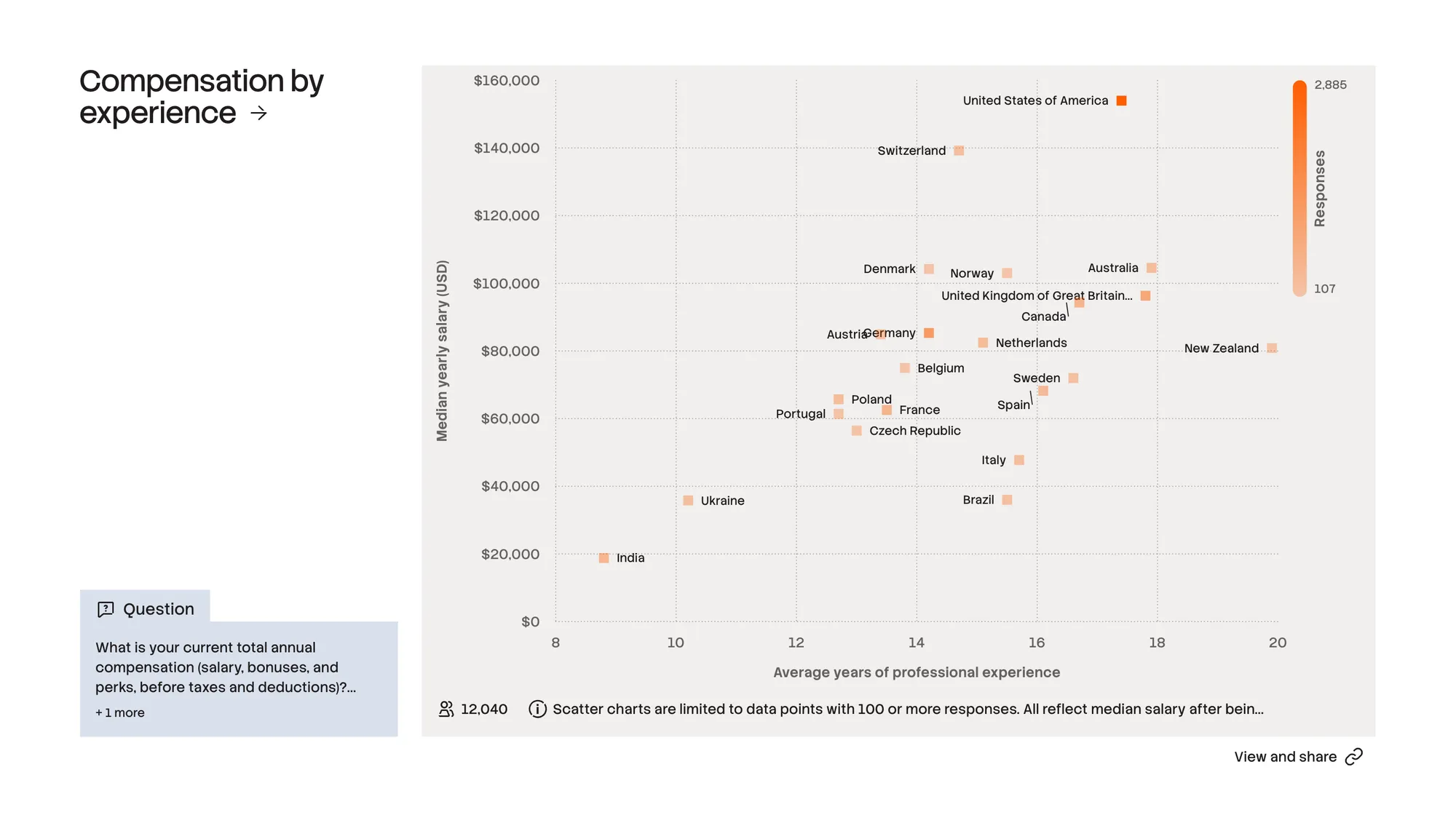
Local pay shows how large the gap is. In Stack Overflow’s 2026 Developer Survey, median total pay was $154,000 a year for developers in the United States, against $65,733 in Poland, $36,002 in Brazil and $18,802 in India. A developer in a lower-cost market who wins clients at international rates keeps far more of each dollar after living costs.
This is not a loophole. It is the logical result of operating in a global market while living in a local economy. Developers who recognize this and actively target international clients, rather than competing only in their local market, access one of the most powerful income multipliers available in freelance work.
The practical path is straightforward: build the skills and portfolio that make you competitive for international clients, and solve the payment side of the equation separately. Ruul makes it possible to invoice clients in 190 countries without a registered company, handling the invoicing infrastructure so the geographic opportunity is not blocked by payment friction.
Nearshore versus offshore premium
Developers in time zones close to their target client market can charge more than those in distant time zones. Latin American developers targeting US clients share most of the working day. Eastern European developers overlap well with Western European clients. That synchronous availability reduces coordination overhead, and clients often accept a higher rate for it.
How client type affects your rate
The same skill set commands different rates depending on who you are selling to. Client type determines both the budget ceiling and the expectations attached to the engagement.
Startups
Pre-seed and seed-stage startups often offer equity alongside lower cash rates. The equity has uncertain value and frequently ends at zero. The lower cash rate is real. Startup engagements carry high flexibility expectations, close collaboration, shifting requirements, and a pace that can be exhausting for developers used to more structured environments.

Series B and above startups have budgets that approach enterprise levels. If you are considering startup work, the funding stage matters more than the label.
SMBs
Small and medium businesses are typically less technically sophisticated than startup clients, which can work in both directions. Fewer adversarial scoping conversations and less micromanagement on technical decisions. But unclear requirements and shifting definitions of done create their own friction. Rate expectations sit in the mid to lower range, and these engagements require more client education than enterprise work.
Enterprise
Enterprise clients have the largest budgets and the most deliberate processes. Procurement requirements, vendor approval cycles, and multi-stakeholder sign-offs slow the engagement start. But the rate ceiling is genuinely higher, particularly for specialized work where the enterprise has few viable alternatives. Payment terms often run Net 30 to Net 60, which matters for cash flow planning.

Agencies
Agency engagements involve subcontracting. The agency marks up your rate to their end client, which means your rate is lower than the value you deliver. The offsetting benefit is volume. Agencies with consistent work can provide a steadier income base than the feast-and-famine pattern of direct client work. Treat agency rates as a volume discount, not as your market rate.
Direct consumer projects
Individual consumer clients have the smallest budgets, the highest scope ambiguity, and the most challenging payment dynamics. These engagements make sense for early portfolio building and almost nothing else. Exit this market as quickly as your experience level permits.
Platform rates versus direct client rates
Platform rates and direct client rates occupy different positions in the market, and the gap between them is significant.
Freelancers working through platforms like Upwork compete where client budgets are low. In Vollna’s analysis of more than two million projects posted on Upwork in 2025, the median hourly budget for web development jobs was $15 to $35. The platform provides client discovery and payment security. The cost is a lower effective rate, plus platform fees that reduce take-home further.
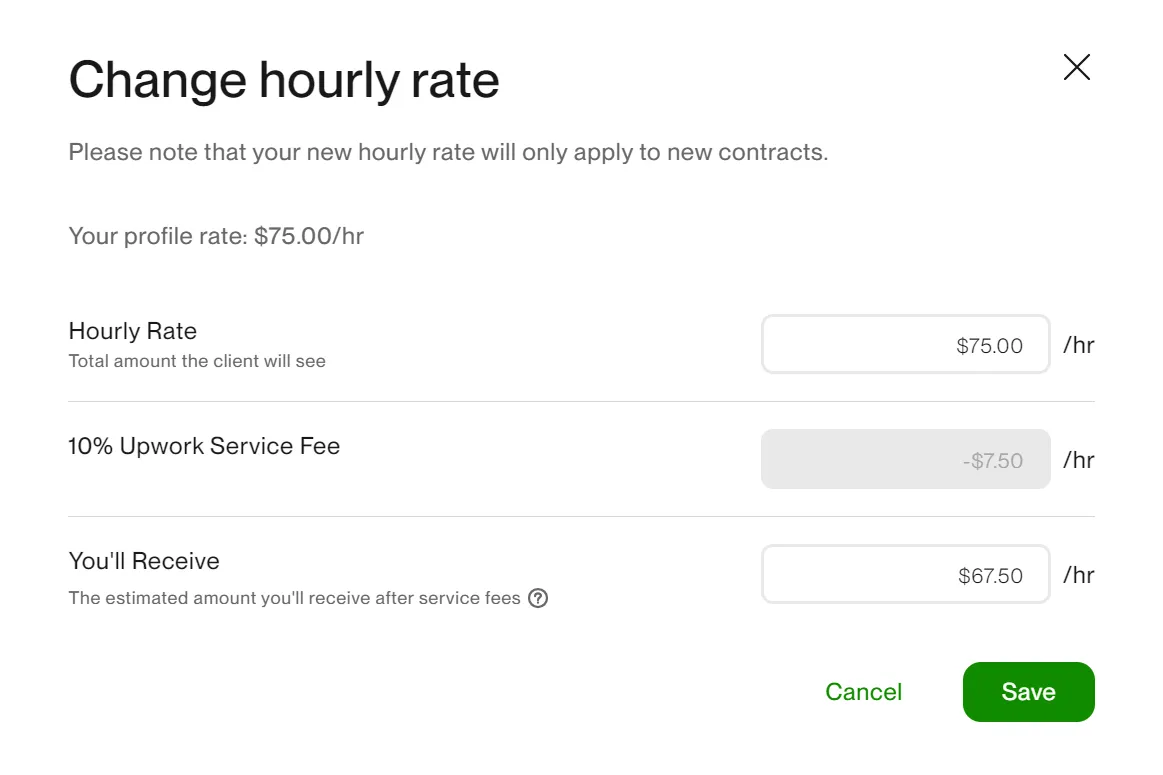
Upwork changed its fee structure in May 2025. Since then, the freelancer service fee is set per contract, from 0% to 15%, based on the type of work and on supply and demand. It replaced the flat 10% fee Upwork had charged since May 2023, when it retired the old 20/10/5% sliding scale. You see the percentage before you submit a proposal or accept an offer, and it stays fixed for the contract. Check Upwork’s fee page before pricing your work.
Platform rates are not wasted. A strong Upwork profile with verified work history and consistent five-star reviews commands rates well above the platform average. The visibility advantage is real for developers building their first client base.
Direct client relationships justify higher rates because you avoid platform fees and the commodity feel of bidding against dozens of other profiles. At the same hourly rate, moving from a 15% platform fee to Ruul’s 5% per paid invoice raises your take-home by about 12%. Find those clients off the platform, though: clients you meet on Upwork have to keep the work on Upwork for two years unless the conversion fee is paid.
Toptal’s vetting process functions as a quality signal to clients: Toptal-listed developers command premium rates within vetted talent markets because the screening process provides a credibility shortcut that clients pay for.
How to research rates for your specific market
Published rate ranges are too broad to act on directly. Your actual target is more precise: what experienced developers at your level, in your stack, working with clients in your target market, are actually charging right now.
Start with Upwork. Filter job postings by your tech stack and examine both the budget ranges clients post and the rates on profiles with strong review histories in your specialty. This gives you the live market signal rather than a retrospective survey.
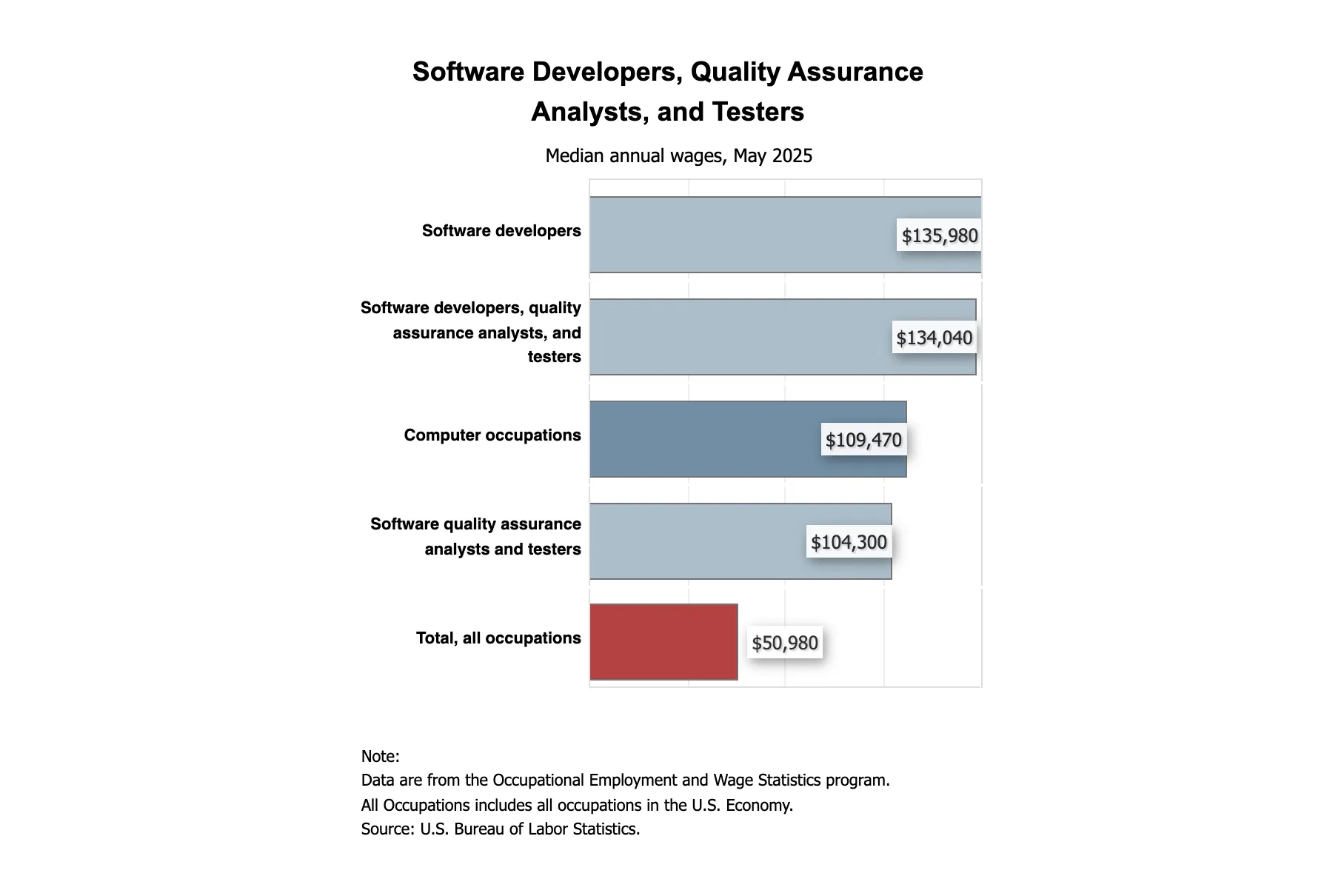
Salary data for equivalent employed roles in your target client’s market is a useful secondary benchmark. In the US, the Bureau of Labor Statistics puts the median wage for software developers at $135,980 a year (May 2025), about $65 an hour. For other countries, Stack Overflow’s 2026 survey gives median pay by country and role. Your freelance rate has to sit well above that hourly figure. For full-time private-sector workers, US employers spend another 46% on top of wages on benefits such as paid leave, insurance, retirement and their share of payroll taxes, according to the BLS. As a freelancer you cover all of that yourself, and you aren’t paid for every hour you work. The resulting number gives you a floor, not a ceiling.
Peer conversations remain the most accurate source available. Developers in your specific niche who are willing to share rates reflect current market conditions better than any aggregated survey. Online communities, Slack groups for specific frameworks, and local meetup networks are where these conversations happen.
Client conversations yield useful signals if you listen for them. Clients who have hired developers previously often share budget ranges during early discussions, either directly or through the scope of what they describe. These signals calibrate your sense of what is realistic for a given client type and project scope.
Cross-reference any benchmark against multiple sources. A single platform’s data reflects the rates on that platform, not the broader market. Any benchmark becomes outdated quickly in a market that moves as fast as technology development. Verify before anchoring.
How AI tools are reshaping developer rates in 2026
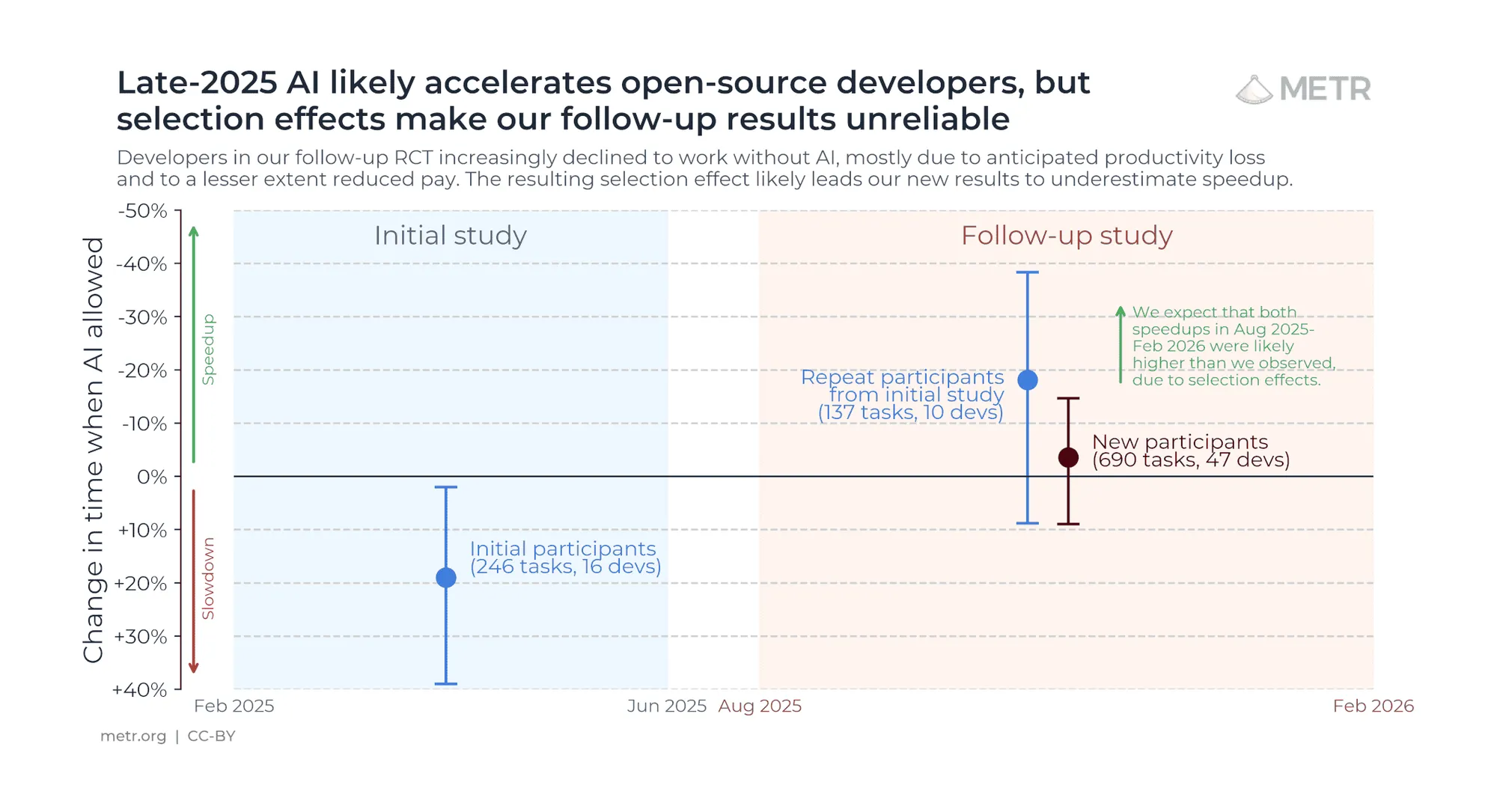
AI coding assistants, including GitHub Copilot, Cursor, and Claude Code, are now part of most developers’ daily work. In Stack Overflow’s 2026 survey, 66% of developers used AI coding assistants or agents at work, and 73% of those used them every day. The productivity gain is real but uneven. In three field experiments with 4,867 developers at Microsoft, Accenture and a Fortune 100 company, those given an AI coding assistant completed 26% more tasks, with the biggest gains for less experienced developers. Experienced developers on their own projects gained less: in METR’s trials, early-2025 tools made them 19% slower, and late-2025 tools likely sped them up, by an amount METR could not measure reliably.
This creates a structural problem for hourly pricing. If AI tools make you three times faster, and you charge by the hour, the client pays one-third of the previous cost for the same deliverable. You do not capture the efficiency gain. The gain transfers entirely to the client.
Project pricing resolves this. When you charge for a deliverable rather than time, the efficiency gain stays with you. A project that previously took you 30 hours at a price of $3,000 now takes 15 hours. At an hourly rate, your income halves. At a fixed project price, your effective hourly rate doubles.
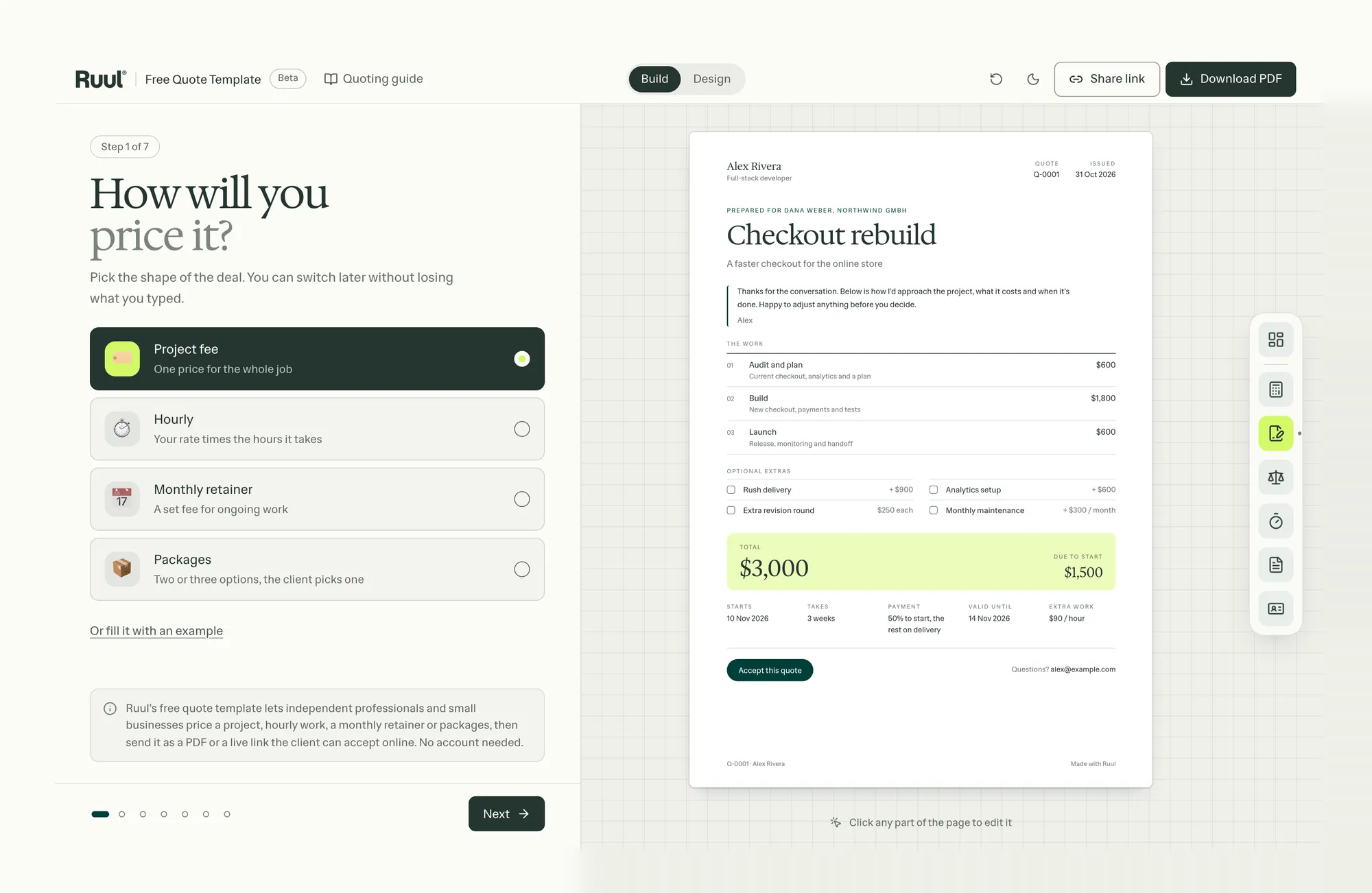
This is the core argument for moving away from hourly pricing as AI tools become standard. The detailed case for that transition belongs in a discussion of pricing models more broadly, but the direction is clear: developers who move toward project and value-based pricing will capture AI efficiency gains, while those who stay on hourly rates will pass those gains to clients.
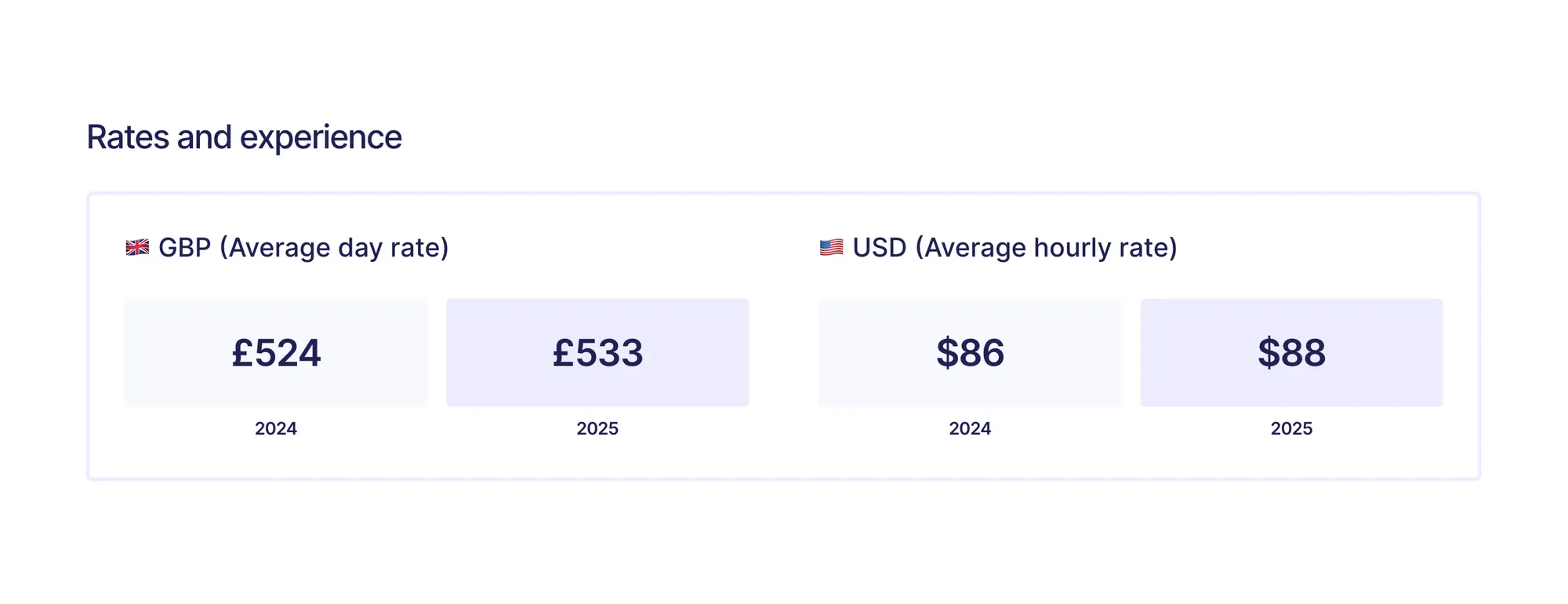
On the market rate side, rates for experienced developers have held up so far, while demand for routine work has fallen. In YunoJuno’s 2026 rates report, UK software engineers averaged £533 a day in 2025, up from £524 in 2024. After ChatGPT launched, coding job posts on a large freelance platform fell about 20%, while pay for the automation-prone jobs that remained rose slightly, which the researchers put down to the simpler jobs disappearing first, according to researchers at Imperial College London, Harvard Business School and the German Institute for Economic Research. On Upwork, web, mobile and software development projects fell 13% in 2025, while AI app and integration projects doubled, according to Vollna’s analysis of over 2.2 million projects.
Highly specialized and judgment-intensive work is least affected by this dynamic. Architecture decisions, security review, system design, and the integration of AI systems themselves into production environments all require expertise that AI coding tools amplify rather than replace. Demand for developers is still projected to grow: the BLS expects US software developer jobs to grow 10% from 2025 to 2035, against 3% for all occupations, with software for AI among the drivers.
How to increase your developer rate
Rate growth does not happen automatically with time. It requires deliberate positioning.
The highest-leverage move is deepening your specialization. Moving from “I do React” to “I specialize in React performance optimization for high-traffic e-commerce applications” reduces the number of developers you compete with by an order of magnitude. Specialization reduces competition and increases perceived value simultaneously.
Build demonstrable outcomes, not just a portfolio of deliverables. Clients making rate decisions respond to specifics: performance improvements measured in milliseconds, revenue impact tied to a feature you built, scale achieved after you optimized a system. Case studies with concrete metrics justify rates that portfolios alone cannot.
Move up the client ladder intentionally. Identify your lowest-paying clients and replace them over time with higher-budget alternatives. This is uncomfortable in the moment and consistently effective over time.
Adding architectural judgment to your toolkit is how senior rates become credible. Clients paying senior rates expect system-level thinking, not just implementation quality. Demonstrating that you identify problems before they become expensive, that you think about the next year’s technical decisions and not just the current sprint, is what separates mid-level rates from senior rates.
Target international clients. Developers in lower-cost markets who work with clients in high-rate markets access significantly better income without moving. This is the geographic arbitrage opportunity, and it requires two things: the skills to be competitive in a demanding client market, and the infrastructure to get paid without friction. Ruul handles the payment side: you invoice clients in 190 countries and get paid in more than 140 currencies within one business day after your client pays.
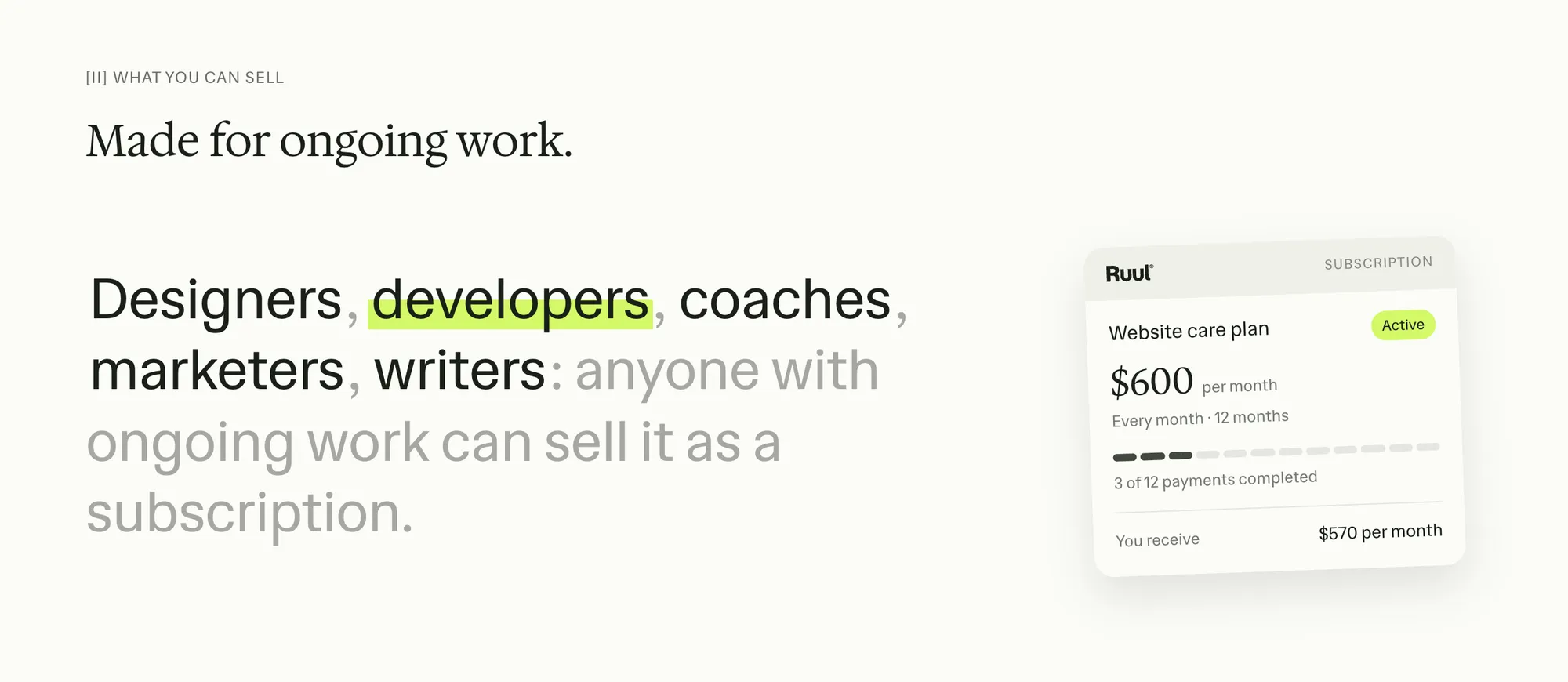
If you work on ongoing retainer arrangements with international clients, subscription invoicing through Ruul handles the recurring side: your client approves once and pays by card on the schedule you set, and Ruul issues each invoice, so long-term client relationships take less admin.
For keeping financial records in order as your client base grows, Ruul keeps your invoices, tax documents and exportable transaction summaries in one place, which matters when you are invoicing across multiple currencies and client types.
The real number
Your rate is not found in a published table. It is a function of your stack, your demonstrated experience, your clients’ geography, and the type of organizations you choose to work with.
The range from $20 to $220 an hour collapses when you apply those four variables honestly. A senior Rust engineer targeting US enterprise clients has a very different floor and ceiling than a mid-level WordPress developer competing on a global platform. Same profession. Entirely different market.
Know which market you are in. Then optimize for moving to a better one.
The highest developer rates come from clients in high-paying markets. Ruul makes it straightforward to invoice those clients in 190 countries without a registered company, so the geographic opportunity that comes with your skills does not get blocked by payment logistics. And if you’d rather receive your earnings in crypto, you can withdraw in USDC while your clients pay the usual way.
Rate figures in this guide come from YunoJuno’s 2026 rates report (more than 182,000 booking, rate and workforce data points from 2024 and 2025), the Stack Overflow Developer Survey 2026 (30,903 responses), the US Bureau of Labor Statistics (May 2025 wages), Vollna’s analysis of over 2.2 million Upwork projects posted in 2025, Upwork’s Future Workforce Index 2026, and Arc’s 2026 rate guide, which blends market observations with Arc’s older survey of 5,302 freelance developers. All figures are directional benchmarks, so check them against live market data before you set a price.
Written by · Co-founder