Your rate comes from three things: what your field pays at your level, what work costs where your clients are, and how you charge. This guide shows what each one does to a price, with the same figures the calculator uses, so you know why a number is what it is before you quote it.
How much should you charge as a freelancer?
Charge the typical rate for your field and level in your client's market, then adjust it for the job: its size, its deadline and who the client is.
That's what the calculator does. Choose how you charge (by the hour, the project or the month), answer a few questions, and the card gives one price with the market's spread under it. The typical price is the middle of the market for your profile. The range under it is the middle half: a quarter of freelancers like you charge less than its low end, and a quarter charge more than its high end.
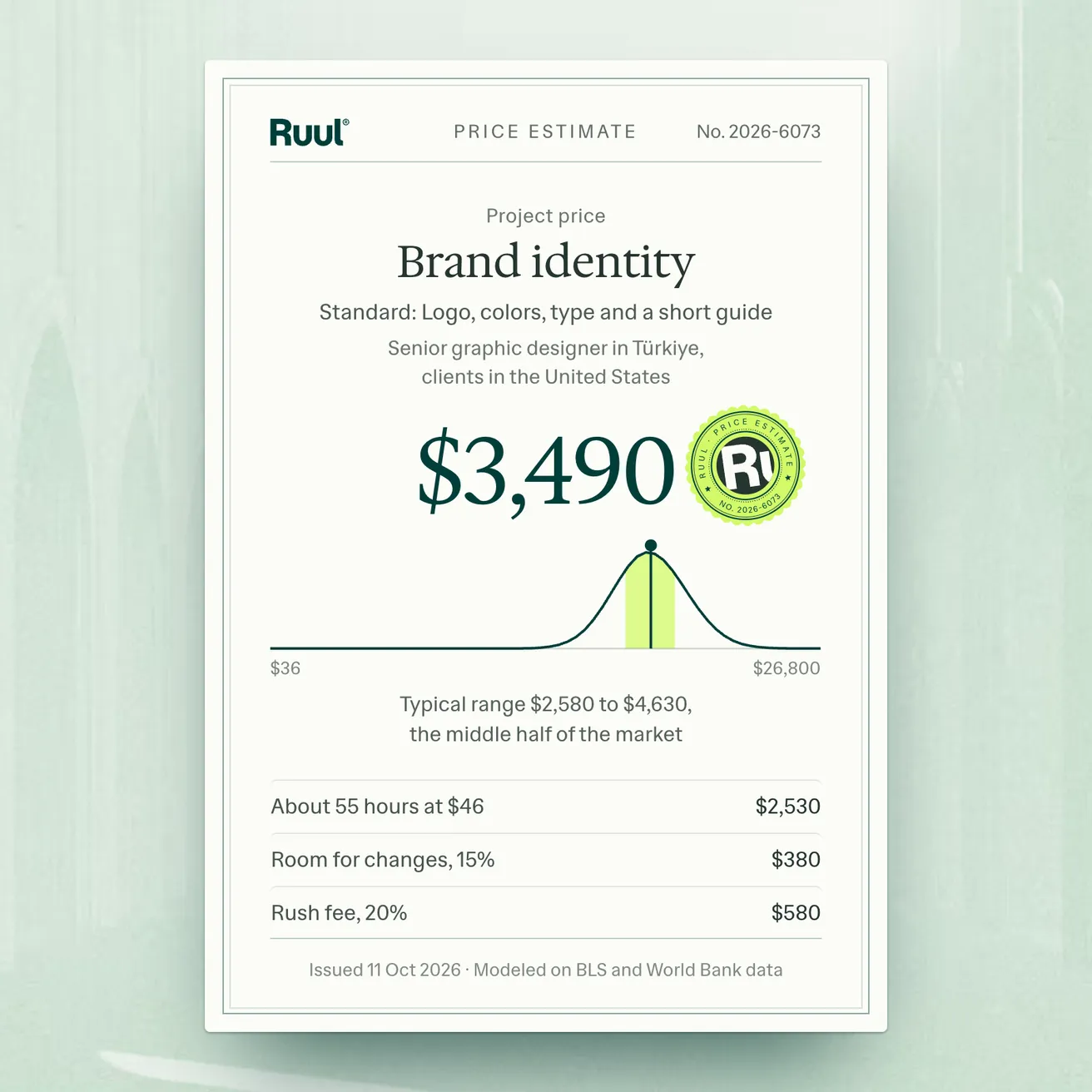 A senior graphic designer in Türkiye with clients in the US: one price, the market's middle half under it, and what the price is made of.
Quote near the top of the range when you have strong references, rare skills or a client in a hurry. Quote near the bottom when you're new to a field or a market and need your first reviews. Going below the range rarely wins better clients, only more of the ones who compare on price alone: it's the first of the common pricing mistakes.
Freelance rates by field
Most fields sit between $50 and $100 an hour for a mid-level freelancer in the US with US clients. Virtual assistants, customer support and tutoring sit below that, and consulting, voice-over and coaching above it.
Typical hourly rates for the most-searched fields, for a mid-level freelancer in the US with clients in the US, in US dollars:
Freelance hourly rates by field: a mid-level freelancer in the US, clients in the US, US dollars | | Low | Typical | High | Day rate |
| Tutor | $34 | $45 | $61 | $360 |
| Graphic designer | $41 | $54 | $74 | $430 |
| Photographer | $51 | $70 | $100 | $560 |
| Virtual assistant | $28 | $35 | $43 | $280 |
| Social media manager | $40 | $58 | $86 | $460 |
| Project manager | $59 | $80 | $110 | $640 |
| Business consultant | $87 | $120 | $165 | $960 |
| Web developer | $55 | $80 | $115 | $640 |
| Copywriter | $50 | $70 | $99 | $560 |
| Content writer | $42 | $60 | $85 | $480 |
| UX/UI designer | $51 | $77 | $115 | $620 |
| Video editor | $35 | $52 | $78 | $420 |
| SEO specialist | $51 | $75 | $110 | $600 |
| Bookkeeper | $41 | $50 | $63 | $400 |
| Translator | $38 | $52 | $72 | $420 |
Low and high are the 25th and 75th percentiles of the field's market. A day rate is eight hours at the typical rate. All 35 roles, at every level, for freelancers and clients in 195 countries, are in the rate index: switch to it at the top of the page.
For a closer look at single fields, see the rates for writers, designers, developers, consultants, AI consultants, social media marketers, digital marketers and creators.
How experience changes your rate
Experience moves you up your field's market: a senior freelancer typically charges about a third more than a mid-level one, and an expert about three quarters more.
Typical hourly rates by experience for three fields, with the freelancer and the clients in the US, in US dollars:
Typical freelance hourly rates by experience, freelancer and clients in the US, US dollars | | Graphic designer | Copywriter | Software engineer |
| Junior, 0 to 2 years | $38 | $46 | $69 |
| Mid-level, 3 to 5 years | $54 | $70 | $100 |
| Senior, 6 to 9 years | $71 | $93 | $125 |
| Expert, 10 years or more | $91 | $125 | $160 |
How big each step is comes from the field's own pay: where the best-paid earn far more than the middle, as for illustrators and voice-over artists, experience counts for more.
Past 10 years, the calculator adds 2% a year, up to 20% at 20 years or more. The wage data stops at each occupation's top tenth, which is the expert rate in the table above, but a long record keeps earning more.
Starting out? Price at the junior rate for your field rather than below it: the junior rate already allows for less experience. Move up once you have a few finished projects and a client who would recommend you. On marketplaces such as Upwork, new freelancers often start lower to win their first reviews; keep that phase short.
How your country and your client's country change your rate
Remote work is priced mostly where it's bought: the same work earns more from a client in a high-cost market, wherever you work from.
The calculator blends the two countries' price levels, giving the client's country 60% of the weight and yours 40%. A mid-level web developer in Poland typically charges about $37 an hour to Polish clients and $59 to US clients; one in the US charges $80 to US clients and $51 to Polish ones. Typical hourly rates for that developer, by where they work and where their clients are, in US dollars:
Same work, different markets: typical hourly rates of a mid-level web developer, US dollars | | Clients at home | Clients in the US | Clients in the UK | Clients in Germany |
| United States | $80 | $80 | $73 | $69 |
| United Kingdom | $68 | $75 | $68 | $65 |
| Germany | $62 | $72 | $66 | $62 |
| Poland | $37 | $59 | $54 | $51 |
| Türkiye | $27 | $52 | $47 | $44 |
| India | $20 | $46 | $42 | $40 |
| Philippines | $28 | $53 | $48 | $45 |
| Nigeria | $19 | $45 | $41 | $39 |
| Brazil | $37 | $59 | $54 | $51 |
| Mexico | $42 | $62 | $56 | $53 |
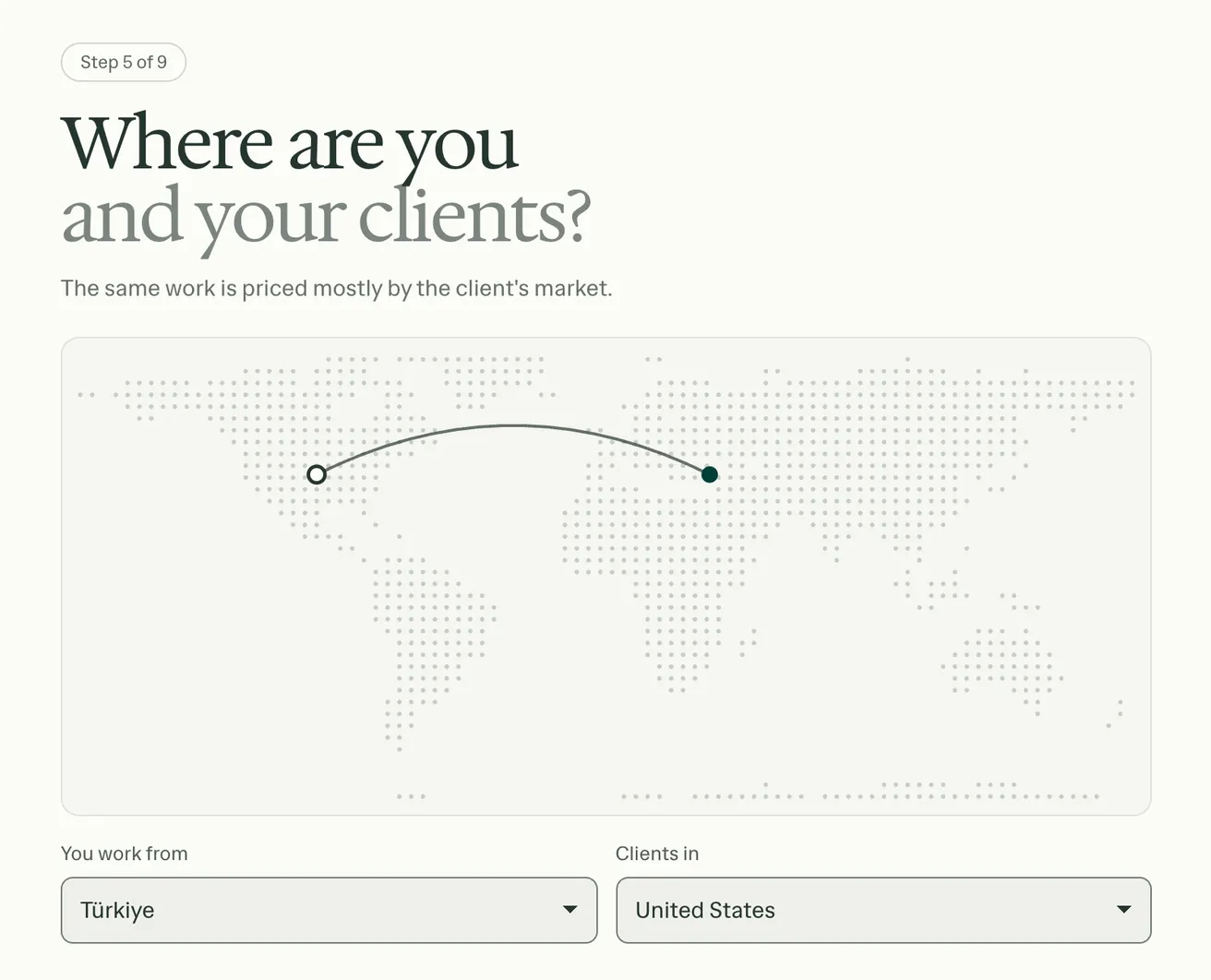 You pick both countries, from 195: the price follows the client's market more than yours.
Keep a price for each market you work in rather than one price for everyone. With Ruul you can invoice clients abroad without registering a company and get paid in 140+ currencies. For how rates differ by region, see global freelance rates.
How to calculate your minimum hourly rate
Your minimum rate is what you need in a year (your pay, your costs and your taxes) divided by the hours you can actually invoice.
- Add up what you need: What you want to take home in a year, and your business costs on top: software, equipment, insurance, an accountant and the fees on your payments.
- Add your taxes: Tax falls on your pay, not on your costs, which come off your income first. Divide your take-home pay by one minus your tax rate, then add your costs. If 30% goes to tax, divide by 0.7: adding 30% on top leaves you short.
- Count the hours you can invoice: Not every working hour. Finding clients, admin and invoicing take a third or more of the week, and holidays take weeks, which leaves a full-time freelancer about 1,000 to 1,400 hours a year to invoice.
- Divide: The year's total over those hours is the lowest rate that pays for your life and your business.
For example:
A minimum hourly rate worked out from a year's pay, costs and taxes, US dollars | | Amount |
| Take-home pay for the year | $48,000 |
| Business costs | $6,000 |
| Needed before 30% tax | $74,571 |
| Hours you invoice in a year | 1,200 |
| Minimum rate | $62 an hour |
Then set it against the market: charge the higher of your minimum and the typical rate for your field, level and client's market. If your minimum is the higher one, the market you sell to is the lever: clients in a higher-cost country pay more for the same work.
Hourly, project or monthly: which pricing model fits
Charge by the project when the scope is clear, by the hour when it isn't, and by the month for steady, ongoing work.
Four ways to charge, when each fits and how its price is built | | Best when | How the price is built | Who carries an overrun |
| By the hour | The scope keeps changing, or the client wants to pay for time | Hours worked × your rate | The client |
| By the project | The scope and the deliverables are clear | The hours the project usually takes × your rate, plus room for changes | You |
| By the month | The work is ongoing and steady | The month's hours × your rate, less a discount for a longer commitment | Shared: the month's agreed work sets the limit |
| By the day | Work is booked in days, on site or in short sprints | Eight hours × your hourly rate | The client |
Pricing by value is another way: you charge for what the result is worth to the client, not for the hours. It suits work with a result you can measure, like a sales page that lifts sign-ups or documentation that cuts support tickets, for a client with a real stake in it. And it keeps paying as you get faster, where an hourly rate pays you less for the same result.
Ask before you price: what is the problem costing the client now, and what is solving it worth to them? Then price at a share of that, never below your market rate. It takes that conversation, so the calculator doesn't model it.
Here is one job priced all three ways from one rate, for a mid-level web developer in Türkiye working for a startup in the US:
One job, three prices: a mid-level web developer in Türkiye, a startup client in the US | | What the client buys | Price |
| By the hour | An hour of work; a day of eight hours is $420 | $52 an hour |
| By the project | A five-page website: about 60 hours, with room for changes | $3,590 |
| By the month | 20 hours of development a month, on a three-month commitment | $988 a month |
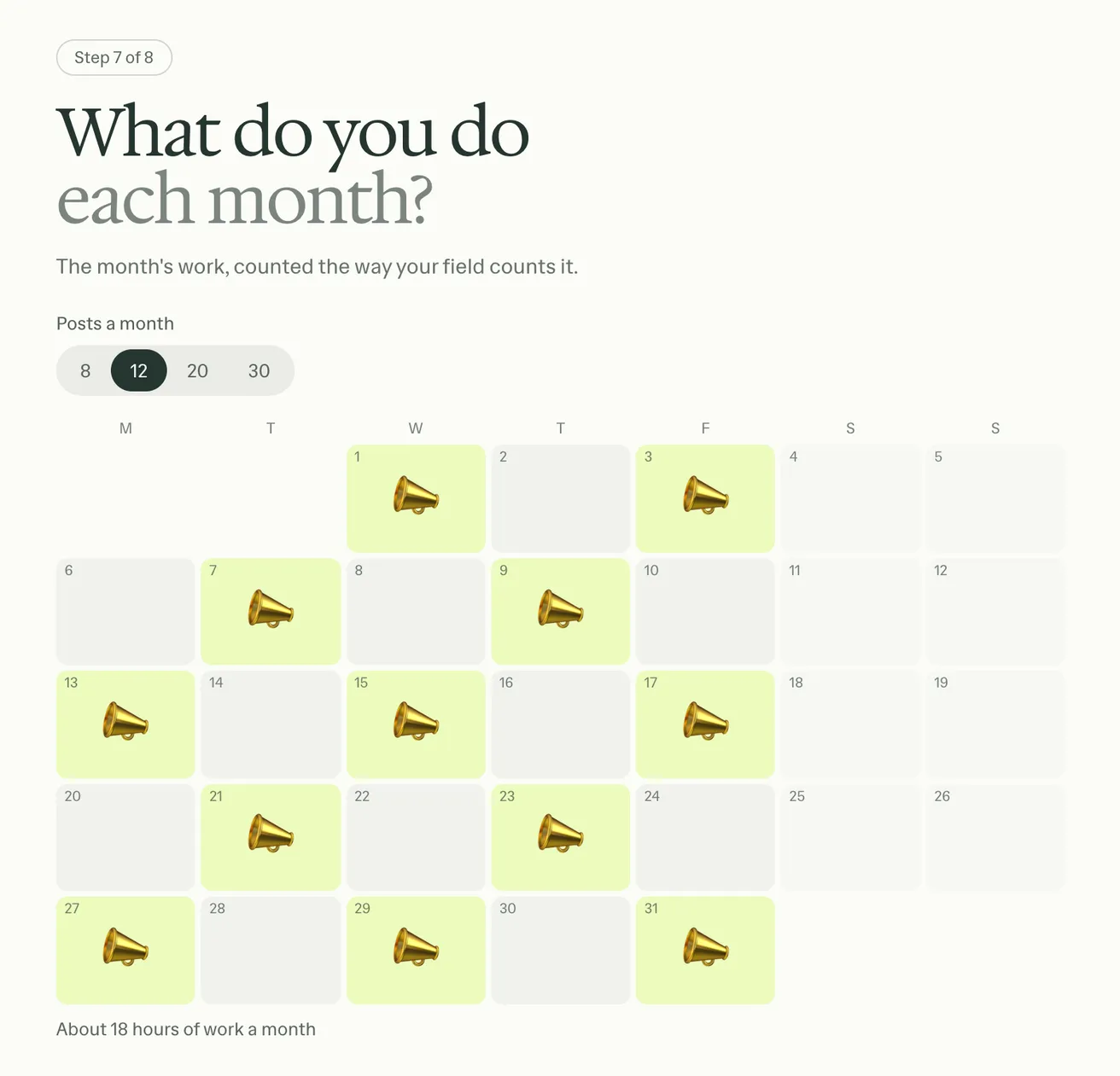 A monthly fee starts from the month's work, counted the way your field counts it: here 12 posts over the month's working days.
Each model is invoiced its own way: a project on one invoice to your client, or a deposit first and the rest on delivery; a retainer as a recurring invoice that goes out every month. Hourly vs project pricing and retainer vs project pricing weigh the models in more depth.
Rush fees, client type and other things that move the price
A tight deadline, a large client and complex work push a price up; individual clients, simple work and longer commitments bring it down.
What changes the price in the calculator, and by how much:
What moves a freelance price in the calculator, and by how much | | Effect on the price |
| Rush, by the hour | +25% within 48 hours, +50% within 24 hours |
| Rush, by the project | +20% within a week, +50% within 48 hours |
| Client | Individual −15%, small business −5%, startup no change, agency −10%, large company +22% |
| Complexity, by the hour | Straightforward −15%, complex +25% |
| Room for changes, by the project | Small +10%, standard +15%, large +20% |
| Commitment, by the month | Three months −5%, 12 months −10% |
Rush fees are a common convention, not a rule, and many freelancers charge more for same-day or weekend work. Put the fee in your quote before you start, so the client picks the deadline knowing its price.
Two more charges belong in your terms rather than your rate. A kill fee is the part of the price a client pays if they cancel midway, commonly a quarter to a half. A fee for changes beyond the rounds you agreed keeps a project from growing past its price.
How to quote a project
A good quote names the work, the price and the terms behind it, so the client can say yes without a call.
- Pin down the scope: List what you'll deliver and what you won't. The size sets the hours: two logo concepts with three rounds of changes is a different job from three concepts and a logo guide.
- Count the hours: Estimate them from similar projects, or start from the calculator's sizes.
- Price the hours: Multiply them by your rate for this client's market.
- Add room for changes: 10 to 20%, more for bigger projects, and say how many rounds it covers.
- Add a rush fee if the deadline is tight: Name the deadline it pays for.
- Set the terms: A deposit to start (often 30 to 50%), when the rest is due and how long the quote stands.
A quote is a fixed price the client accepts; an estimate is your best guess, which can change as the work does. Quote when you can, and estimate only while the scope is still moving. Once the client says yes, turn the quote into an invoice.
Say the price once, plainly, with what it buys: “$3,490 for a brand identity: logo, colors, type and a short guide” lands better than “around $3,500, give or take,” which invites haggling over the price instead of the scope. Say what the work solves before the number, so the client weighs the price against that. If a client pushes back, ask what's behind it: a budget limit calls for a smaller scope, not a lower rate.
When and how to raise your rates
Raise your rates when you're booked out, when clients accept your quotes without pushback, and at least once a year as your experience grows.
Start with new clients: quote them the new rate and see how it lands. Give existing clients a month or two of notice, ideally before a renewal or a new project, in a short note: the new rate, when it starts, and what stays the same. Negotiating a better rate and growing your freelance income go further.
Where these numbers come from
The figures are a model built on public data, not a record of what freelancers charged, and not a source to cite.
- Fields: What employees in each occupation earn in the US, from the US Bureau of Labor Statistics (May 2025). Freelancers charge about 1.8 times that hourly wage, as published freelance rates show, with an adjustment for each field where those rates differ.
- Experience: Each occupation's own pay spread: junior near its lowest quarter, mid-level at its middle, senior at its upper quarter and expert at its top tenth. Past 10 years, 2% more a year, up to 20%.
- Countries: The World Bank's price levels, averaged over five years. The client's country carries 60% of the weight, yours 40%.
- Currency: Every price is in US dollars.
What the calculator doesn't know is your own side of the price: your costs, your taxes and any platform's fees. It can't tell you the lowest rate you can live on; work that out from your costs, as in the minimum hourly rate above, and charge the higher of the two. Keeping your invoices and expenses in one place makes that sum easier and keeps you ready for tax time.
From a rate to getting paid
A price only counts once it's paid. Send your invoice through Ruul, and Ruul invoices your client as the legal counterparty, collects the payment and pays you out.
You don't need a company: you can invoice clients in 190 countries as an individual. Payouts reach you in 140+ currencies, usually within one business day of the client's payment, and reminders go out on their own when an invoice is late. Ruul's pricing is 5% per transaction, with no setup or monthly fee. If a client pays late anyway, late payment fees are worth setting in your terms.
Questions
How much should I charge as a freelancer?
Start from the typical rate for your field and level in your client's market, then adjust it for the job's size, deadline and client. For a mid-level freelancer in the US working for US clients, most fields sit between $50 and $100 an hour. The calculator gives the figure for your own profile.
What is a good hourly rate for a beginner freelancer?
The junior rate for your field. In the US it runs from about $25 an hour for virtual assistants and customer support to $70 to $80 for software engineering and consulting, and more for coaching. Move up once you have a few finished projects and references.
How do I calculate my hourly rate?
Two ways, and charge the higher result. From the market: the typical rate for your field, level and client market, as the calculator gives it. From your costs: what you want to earn in a year plus your business costs and taxes, divided by the hours you can invoice, often 1,000 to 1,400 a year once admin, sales and time off are taken out.
What is a day rate?
A price for a full working day, usually eight hours. The calculator's day rate is eight hours at your typical hourly rate. Some freelancers charge a little more for a day, since a booked day rules out other work.
Should I charge hourly or a flat rate?
A flat project rate when the scope is clear: the client knows the price, and you keep the time you save by working well. Hourly when the scope keeps changing. A monthly fee suits steady, ongoing work.
How does a monthly retainer work?
The client pays a set fee each month for a set amount of work, such as 20 hours of development or eight posts. A longer commitment usually earns the client a small discount: in the calculator, 5% for three months and 10% for twelve.
How much is a rush fee?
Commonly 20 to 50% on top of the price, and more for same-day work. The calculator adds 20% to a project due within a week and 50% within 48 hours, and 25% or 50% to hourly work due within 48 or 24 hours.
When should I raise my freelance rates?
When you're booked out, when clients accept your quotes without pushback, and at least once a year. Raise rates for new clients first, and give existing clients a month or two of notice.